


Intestinal microbiota balance as the basis of performance in broiler chickens
2026-10-28
A study from the University of Carthage (Tunisia), involving 50,000 broiler chickens, recorded a 4.6% improvement in feed conversion ratio and a reduction of 2,670 kg in feed consumption, while maintaining a comparable final body weight.
Intestinal health and feed efficiency: the role of natural microbicides
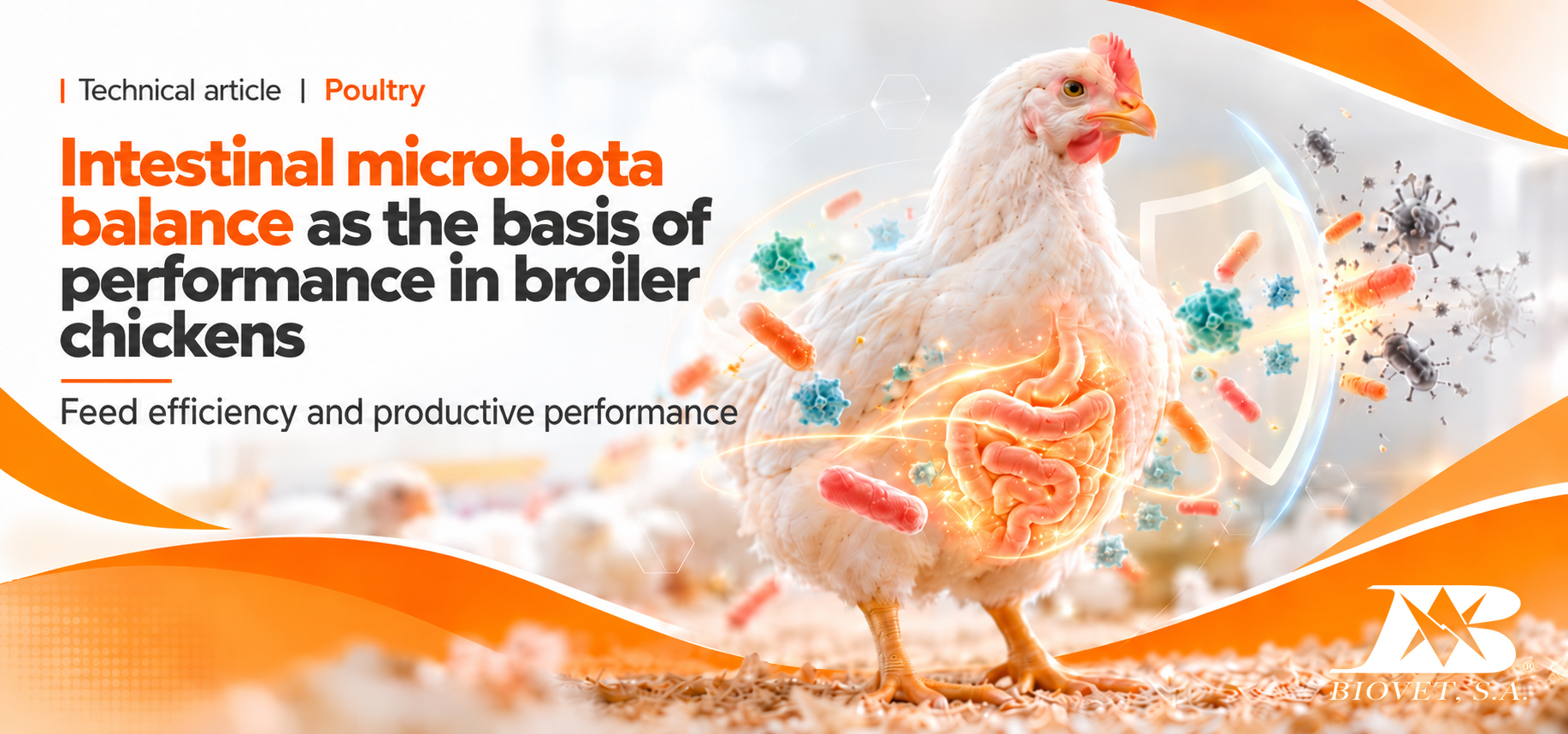
In intensive broiler production, feed efficiency depends on both feed quality and the functioning of the digestive system. Imbalances in the intestinal microbiota, or dysbiosis, can disrupt the intestinal environment and impair nutrient utilisation, with potential consequences for productive performance.
Controlling potentially harmful microorganisms is a strategy of interest for preserving intestinal balance. Certain microbicidal compounds of botanical origin act on the membranes and cellular functions of bacteria and fungi and are used to promote a more stable digestive environment.
Intestinal health, growth patterns and the ability to utilise nutrients are relevant factors in improving feed conversion, which is a priority objective.
Evaluation in 50,000 broiler chickens
A total of 50,000 Cobb broilers were evaluated, divided into two groups of 25,000 birds and housed in separate environmentally controlled poultry houses. Both groups received the same feeding programme; the experimental group received supplementation in the drinking water from day 7 until slaughter, whereas the control group did not receive this supplementation.
During the 32-day cycle, live weight, average daily gain, feed consumption, feed conversion ratio, mortality and various indicators of intestinal integrity were recorded.
A 4.6% lower feed conversion ratio
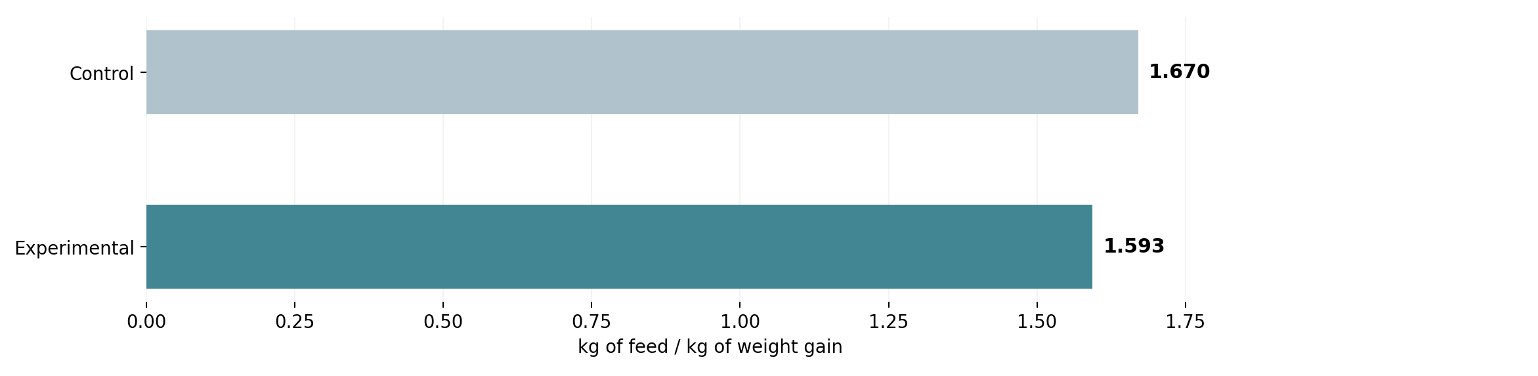
The experimental group recorded a feed conversion ratio of 1.593, compared with 1.670 in the control group: an observed relative reduction of 4.6%. Total feed consumption was also lower in the experimental group.
TABLE 1 | FEED CONSUMPTION AND PRODUCTIVE EFFICIENCY

Descriptive differences recorded during the cycle. No valid inferential comparison of feed conversion ratio between poultry houses is available.
The cumulative difference between groups allows the feed conversion ratio to be expressed in concrete terms: less feed consumed, with a slightly higher total weight gain in the experimental group.
FINAL RESULTS | COMPARATIVE SUMMARY OF THE TWO GROUPS

FIGURE 1 | FEED CONVERSION RATIO AT THE END OF THE CYCLE
Final body weight
Although the experimental group showed lower average body weights than the control group during the first three weeks, this difference progressively narrowed and was no longer statistically significant from day 28 onwards. At the end of the production cycle, the experimental group reached an average body weight of 1,716.9 g per bird, compared with 1,703.7 g in the control group, representing a numerically favorable difference of 13.2 g per bird (p = 0.472).
TABLE 2 | CHANGES IN MEAN LIVE WEIGHT

FIGURE 2 | FEED EFFICIENCY AT THE END OF THE TRIAL

The experimental group recorded lower feed consumption and a lower feed conversion ratio than the control group, while maintaining a comparable final body weight at the end of the trial.
Between days 21 and 28, average daily gain was 93.48 g/bird/day in the experimental group, compared with 85.08 g/bird/day in the control group (p = 0.0014). This period of faster growth helped to reduce the weight differences observed previously.
Intestinal health and nutrient utilisation
Intestinal microbiota balance is relevant to digestive function and nutrient utilisation. An increase in harmful microorganisms can promote disruptions to the intestinal environment and affect feed utilisation. Therefore, in addition to productive parameters, the dysbiosis score was assessed; it was 2.28 in the control group and 1.28 in the experimental group.
TABLE 3 | ADDITIONAL INDICATORS

The experimental group showed a numerically favorable difference in mortality rate, with 5.228% compared with 5.348% in the control group. In addition, the dysbacteriosis score was approximately 43.9% lower in the experimental group. Overall, these results reflect a favorable outcome for the experimental group, particularly in terms of the lower dysbacteriosis score, accompanied by numerically lower mortality and higher average daily gain.
Conclusions
The intestinal microbiota plays a fundamental role in the proper functioning of the digestive system in broilers. Maintaining an appropriate balance helps to support intestinal health and nutrient utilisation, both of which are essential for bird performance.
In this trial, the group supplemented with Alquermold Natural Plus had a lower dysbiosis score than the control group, suggesting a better intestinal condition. Favourable productive results were also recorded, with a feed conversion ratio (FCR) of 1.593 compared with 1.670 in the control group, lower feed consumption and a final body weight 13.2 g higher per bird.
In the overall trial results, the supplemented group consumed 2,670 kg less feed and produced 329.93 kg more meat. These results were observed alongside a lower dysbiosis score, highlighting the importance of intestinal health in broiler performance.
Alquermold Natural Plus contributes to the maintenance of intestinal health by promoting the conditions required for proper digestive function and effective nutrient utilisation, factors that may have a positive impact on productive performance.